A Very Old Man with Enormous Wings – Interactive Analysis

A social and ethical reading through interactive choices.

A Town, an Old Man, and You

Step into a rain-soaked town to examine the story through a social and ethical lens.

In the very beginning of the whole story, the world has already sunk in a very grey and tiring atmosphere. It has rained for days. The sea and the sky have almost mixed into one piece of grey. The beach is no longer shiny; instead, it is now a disgusting mixture of mud and rotten shells. Crabs are crawling into the house one after another, making the house stinker. Pelayo and Elisenda even thought that their baby’s fever is caused by this disgusting smell. The narrator told this story in a very calm tone, and it seems like the sad atmosphere is not something surprising: it’s part of normal life.

In this website, I turned the short story of “A Very Old Man with Enormous Wings” into a virtual town and interpret the story in social and ethical lens. Instead of treating this short story in a religious tale of “the arrival of an angle”, approaching this story in a perspective of “how normal people treat someone weak and strange” is more meaningful and insightful. Pelayo, Elisenda, neighbors, Father Gonzaga, and the curious crowd didn’t really treat the old man as a life that needs respect and care; instead, they treated him as an object that can be explained, used and sold. Through this sequence of reactions, a disturbing fast is uncovered: when something “holy” really appeared in the reality but in a dirty, weak and difficult to understand, most people do not think about respect first, but about safety, morbid curiosity, profit and easy explanation.

This program illustrates the rude and improper treatment towards the old man only for moral and social criticism and analysis instead of supporting, approving or normalize ANY SIMILAR ACTIONS.

Scroll to begin ↓

First Encounter

You step into your courtyard on a rainy day and see someone unexpected.
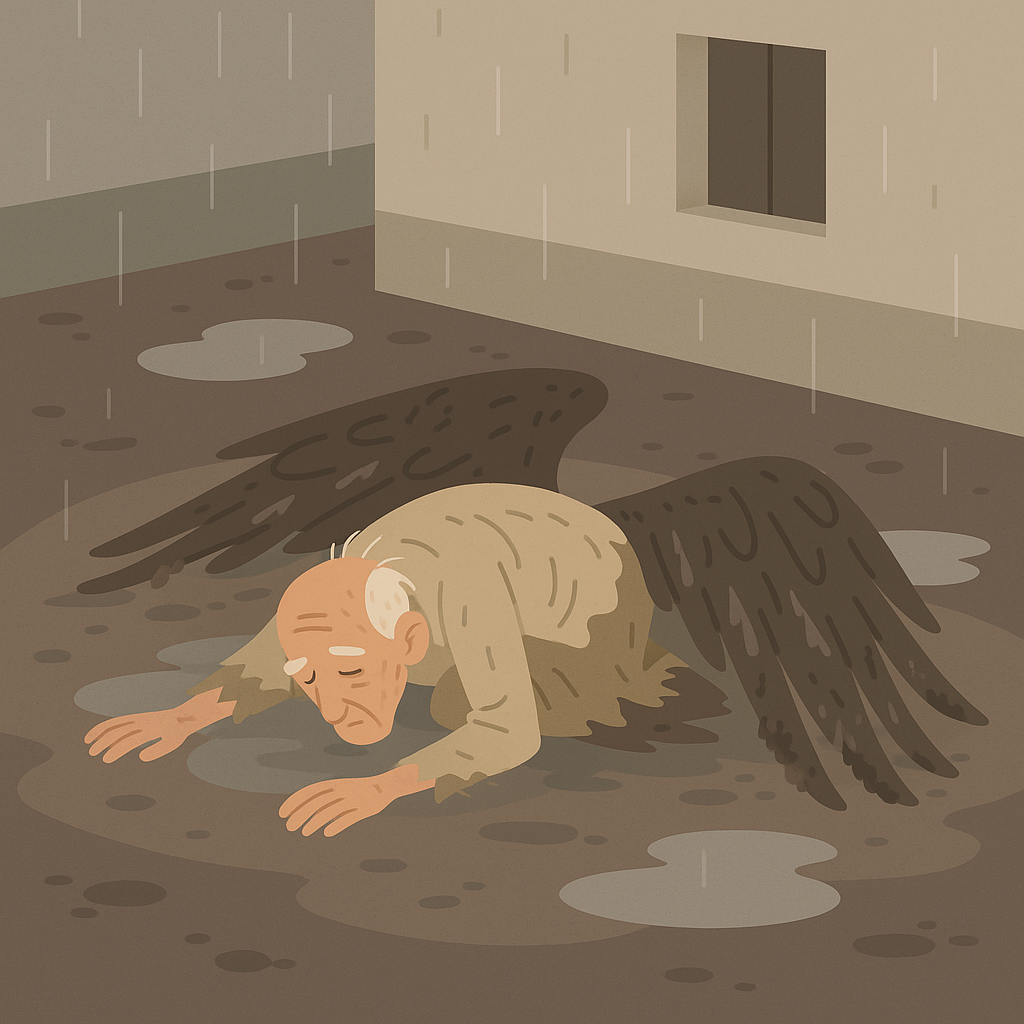
Muddy courtyard with a very old man with enormous wings lying face down

In the story, Pelayo was initially full of fear and distrust to the old man. He dragged the man out of the mud but do not treat him as a patient who requires aid. He held the club and watched him from the kitchen for a whole afternoon. This posture makes this very clear: he does not treat the old man in front of him as a person who needs help; instead, he treated him as a possibly threatening and unknown “object”.

From the perspective of morality, this reaction is very normal: when treating an existing stuff which is strange and hard to explain, the first attempt is always to arm ourselves first instead of checking whether he is all right. This reaction reveals a habit of the whole town formed under long-lasting existing pressure: all strange stuff should be treated as a potential treat instead of potential stuff needs help. This “defense-oriented attitude also lead to a strong base stone for a series of more serious dehumanizing actions happened later in the short story.

In the story, Pelayo and Elisenda initially are just staring at him. As time passed by, the fear gradually disappeared, and the old man stared to be increasingly familiar. This is a calm, and even somewhat frightening process of adaptation: a event that used to be able to shock the whole world is now changing into a scene that can be treated in an ordinary sight.

In the lens of morality, “getting familiar” does not equal to understanding or respect. In this context, familiar isn’t close: it means numb. When a supernatural old man turned into part of the background so quickly, the readers will realize that how skilled this town is at absorbing anything into its existing cold order. Just because they get used to “there’s an old man with wings in the yard”, it became even easier for them to accept ridiculous things like “lock him in the chicken coop” or “treat him as a business”.

Pelayo and Elisenda once even had a thought of “doing something good”: they planned to put some water and food on a raft and push the man back to the sea, letting the sea to decide his fate. It seems like this is a much better solution for locking him in the chicken coop. However, this is still a solution of “sending the problem away” instead of taking the responsibility directly. They are not willing to treat the old man as part of the family or community. They just want to get rid of this old man and send him back to the nature as soon as possible.

In the lens of moral and ethics, this choice shows another kind of indifference that is much more hidden: turning “actively helping others” into an action that “makes themselves feel better” instead of what they need. On the surface, this seems like a solution driven by pity, but it is still treating the old man as “an incident to be dealt with”, rather than an independent individual that can be spoken or lived with.

If you decided to treat the old man as an ordinary patient -- you helped him to wash his body, provide him with food and clean water, and even provide a safe and clean space for him to stay – then you are far from what happened in the story. In fact, nobody did the above things for him: they sometimes give him some food (but mainly fruit peels and breakfast leftovers) but throw him in the corner of the chicken coop for most of the time. This ideal choice on the website is used to show a strong contradiction to the actual story.

This contradicted choice’s value is to make the reader to realize that the problem is never about “there’s no chance for help the old man”: the real problem is that everyone consciously avoided this path. Just because the reader can easily point this right way to care the old man, the indifference of the people in the town is then highly strengthened. The story pointed out a moral problem: people are not unable to do so; they are just unwilling to pay time and risk treating a troublesome strange person as a real neighbor.
Turning Him into a Business

The town decides what the old man is worth.

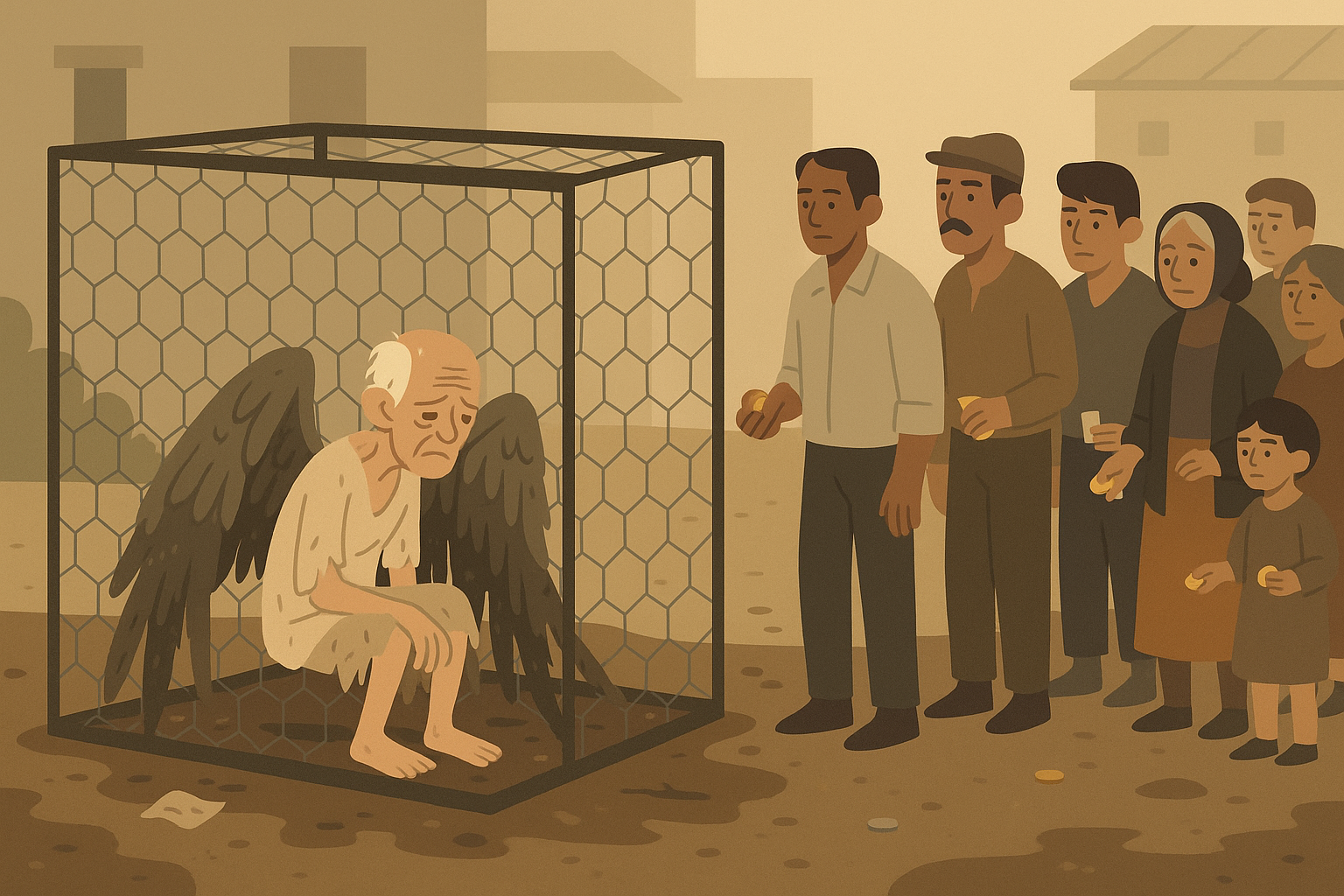
Chicken coop with the old man inside, crowd outside like a market

In the original short story, when Elisenda is cleaning the rubbish all over the yard, she suddenly comes up with the idea of charging every visitor for five cents. The yard is under a mess at that time: people waited in line which queue up beyond the skyline with noise and rubbish filling up the whole yard. In a week, they filled the whole room with money.

From the lens of ethics and morality, this step is the most symbolic activity of “commercial” the old man: they transformed a holy existence into a commercial product for own interest. In addition, many other reviewers pointed out that the author is directly using irony to criticize how consumerism turned “holy” and “extraordinary” into commodities for buying or selling.

For readers, the most shocking point if not about how they charge, but they have nearly zero moral struggle: as they discovered that this can make profit, they naturally turned the old man into a “circus show” for profit. Through this normal tone, the story makes this moral slide appear disturbingly ordinary.

A series of weird people existed in the short story seeking cures: a poor woman who since childhood has been counting her heartbeats and had run out of numbers; a Portuguese man who couldn’t sleep because the noise of the stars disturbed him; a sleepwalker who got up at night to undo the things he had done while awake; and many others with less serious ailments. They wait in line in front of the chicken coop, asking the “angle” to bring they a single wonder. The text illustrated those people in a ironic way, emphasizing that people’s desire of solving problems in an not ordinary method.

From the lens of morality and ethics, the action of “asking for cure” does not deserve a blame: it is definitely reasonable for sick people to ask for help. What makes the short story unsettling is that most people just treated the old man as a “button for solution”: if the outcome fails to meet their requirements, they got mad, disappointed and quickly turn around for another show. They care nothing about who the man is, what he is suffering from: they only cares “whether the old man can solve my problem in the way I want”. Through depicting this utilitarianism behavior, the key theme of utilitarian sacred is pushed to an extreme to emphasize the problem.

If you choose to do nothing, you are standing on the side of the enormous crowd in silence. Although those people never directly beat the old man or directly ask for charge, by watching, gossiping and then turning away, they collectively formed the background of this inhuman scene. Although the text didn’t directly portray them directly, their support in silence enables this inhuman show to last long.

From the lens of ethics and morality, observing doesn’t mean neutral. In this story, if there’s no surrounding crowd, “charge for ticket for visiting the angle” cannot become a business at all. Choosing to do nothing basically means accepting the current situation by default and taking it for granted that the old man is treated like an animal and a commodity. By giving the reader this choice, the project forced you to accept a fact: in the real world, for how many times are we just standing by and watching, refusing to admit that we are all part of the scene?

Miracles, the Spider Woman, and Faith

Which spectacle will you believe?

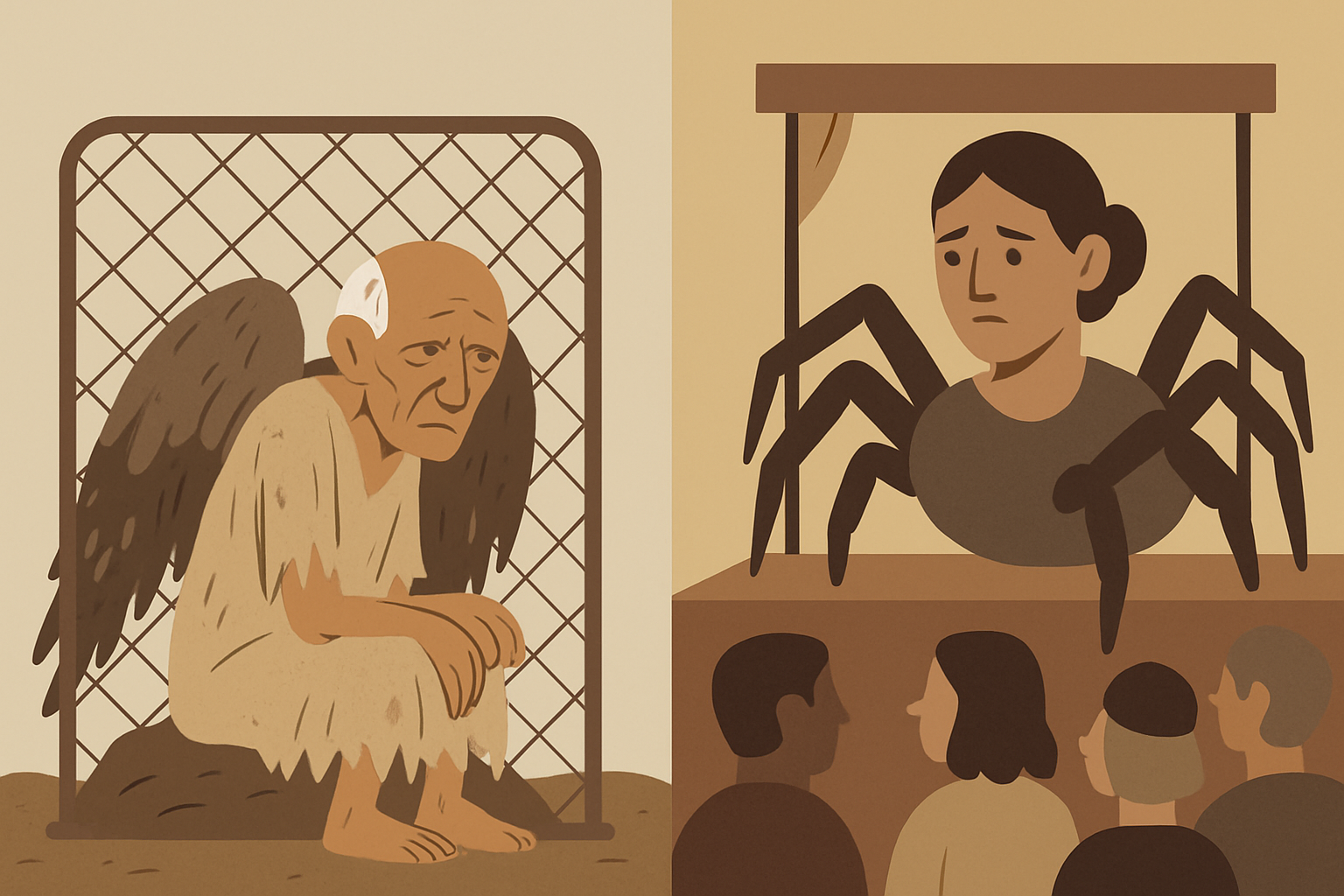
Chicken coop with the old man and a stage with a spider woman drawing a crowd

In the story, some miracles really happened, but all happened in an extremely weird way, like the blind man who didn’t recover his sight but grew three new teeth, or the paralytic who didn’t get to walk but almost won the lottery, and the leper whose sores sprouted sunflowers. For the people asking for help, those outcomes have no logic and have no actual meaning. Therefore, they are all considered strange and fail miracles.

Those wonders are so striking precisely because they are directly inversing people’s expectations: everyone comes with a detailed expectation but finally gets a result that is almost a joke. The sharp contract created an almost ironic effect: even if standing in front of a holy existence, we cannot treat it like a vending machine that delivered exactly the gift we want. In the lens of ethics, this shows the real attitude towards holy stuff deep in mind: people do not care about the truth, they only care about whether their own wants are satisfied.

Later, the town is holding another traveling show: a woman who turned into a huge spider. She has the huge body of a spider and the sad face of a girl. She tells the audience how she disobeyed her parents’ command to stay home and went dancing at night, was struck by lightning, and finally turned into a spider. Audiences are not only allowed to observe her for a short distance but also allowed to ask questions about whatever they want, listening to her telling this story again and again.

People are immediately attracted to see the spider women, since she represents a very “easy to understand” moral story: do not listen to parents’ words, sneak out for a dance, and finally be punished and turned into a spider. This story can use its simple logic to satisfy people’s curiosity to fear and bring them moral comfort. On contrast, the old man in the chicken coop told nothing: he has no clear announcement of himself, no moral storied that is easy to understand. He is just a tied old man, an existence that is hard to understand and classify. The story pointed this theme out directly: people usually love stories that are simpler: there’s just black and white in the story, instead of facing the actual complex and vague real world.

If you choose not to visit the spider women and stay at the chicken coop with the old man, you are on the completely contradictory direction of other townspeople. In the original short story, the spider women easily “beat” the angle: almost all the townspeople move their money and attention to the spider women, leaving the old man to get older alone in the chicken coop. Your choice will form an alternative scene: what nobody did in the real story was supposed on this small website.

This choice of “staying by the old man” is not used to provide the story with a “sweeter” ending: it is just making the reader realizing the fact that the townspeople can actually do this, but they chose not to do. Through this interaction, the website gives the reader a chance trying to be the person who never appeared, and at the same time lets us see more clearly the force of the novel’s criticism – it is not criticizing “the inevitability of fate” – it is showing that people are consciously choosing the most convenient, more entertaining and most pragmatic path.

Figurative Language X-Ray

Filter between imagery, symbolism, and irony.

Imagery means words that can create scenes, sound, smell and feelings. In the very beginning of the short story, the author used very strong imagery to drag readers into a grey world: grey sky and oceans, beach full of mud and rotten shells, houses with crabs crabbing everywhere, and a baby in fever. When reading those words, we can almost smell that stench of decay as well as feeling the cold and wet air. Those details bring a depressing background color at the beginning of the whole story.

The old man’s appearance is also creating a very strong imagery: he looks like an old man being soak by rain. His clothes are a mess, and his wings are dirty and ugly. Those words created an existence that is completely different from that we traditionally portrait an “angle” as. The readers will not see the white and clean wings, but a dirty body with stinky smell. This contradictory of imagery makes the so called “holy” very normal and dirty, forcing us to think of that in the real world, the person who really needs help might never be those who looks like an angle.

Through imagery, the author connected the illusion and the real world together: there are wonders like “the old man with wings” and crabs, mud and stink in the story’s world setting. The story did not use dreamlike and radiant images to emphasize the “angle” but use a bunch of dirty and stinky details to drag him back to the ground. This approach makes readers to realize that the so-called “holy” might not exist in an appearance which is clean and easy to understand; instead, it breaks into everyone’s life in a way that makes people uncomfortable and even want to escape.

The old man’s wing is the most obvious symbolism of the whole story. In common sense, wins usually symbolize sky, freedom and even paradise. This is the reason why people initially connected him to “angle”. However, in most of the time of the story, wings do not bring the old man freedom: they are heavy and dirty, covered by mud and bugs, making the old man even difficult to stand up. People used his feather to rub the damaged regions of their own body, treating it as some “super medicine”. In the perspective of symbolism, wings connected the old man to holy, and remined us that in this current context, his wings are currently in a state of being used and exploited.

The chicken coop is not only a place, but also a symbolism for how the society treats the person who “brings problem”. Locking the old man into the chicken coop indicates that he is formally being considered as an “animal”, instead of a guest, a patient or a holy man. The chicken coop is small, dirty and full of shit and bugs, but it is the place for locking him. This symbolism reveals a cruel reality: when people cannot understand something’s existence, the easiest way to deal with it is to separate it from the public space, transforming him into something that can be observed and exploited.

The spider woman is used to symbolize the story that is “easy to understand and consume”. The spider woman’s face is a sad girl, but her body is a huge spider. This morbid appearance is already dramatic enough, and her story also has a clear structure which is easy to understand: she first disobeyed her parents, and then sneaked out for a dance, and finally being punished by the lightning and turned into a huge spider monster. She is representing a kind of lesson-giving narrative that can be easily packaged and repeatedly sold to the public. The audience can not only satisfy their morbid curiosity but also get a conclusion for comfort. Compared to the old man, the spider women’s symbolism is more accepted by the market and the audience: she does not kept silence but stating a “correct answer” repeatedly. Through this symbolism and contradiction, the story criticized the modern world is escaping from the complicated truth and keen on simplified “correct and easy” stories.

The irony is mostly reflecting on those so-called “wonder”: the blind man wants to see brightness again but get three new teeth; the paralytic wants to walk again but get luck for almost winning a lottery; the leper wants cure but get sunflowers on his sores…… Those results are not completely negative but are all far away from what people exactly wants and even includes some “black humorous”. This irony makes us to realize that even if there’s really some “supernatural” power entered the human world, it may not run in the exact way how we want it to operate. Treating “holy stuff” as tools to satisfy individual’s own wiliness is always a dangerous illusion.

The fame of the old man is also a kind of irony. In the very beginning, people are thinking of giving him various “great identity”: some people want him to be the leader of the whole world, the top general of the army, or even be put to stud to implant the earth a race of winged wise men who could take change of the universe. But sooner, he almost loses all his fame due to the performance of the more “morbid show” of the spider woman. The irony of a real holy existence being ignored due to a “monster show” make the reader to understand that what people chasing is usually not the truth: it is usually just a sense of novelty and simple excitement.

The end of the story is very ironic: when the old man finally got new feathers and drag his old body to the free sky, for the readers, it is a moment closest to wonder after suffering long time of inhuman treatment and ignorance, he finally leaves the town for a free life. However, for Elisenda, the emotion bought by this moment is mainly relief: lift has finally become one trouble lighter. When she stared at him flying to the sky and finally disappeared, she was not feeling kind of moved or surprised, but only some kind of relief. The reader’s sense of wonder contrasts sharply with the characters’ relief, turning the ending into a striking piece of irony.

Comparison: A Painting and a Story

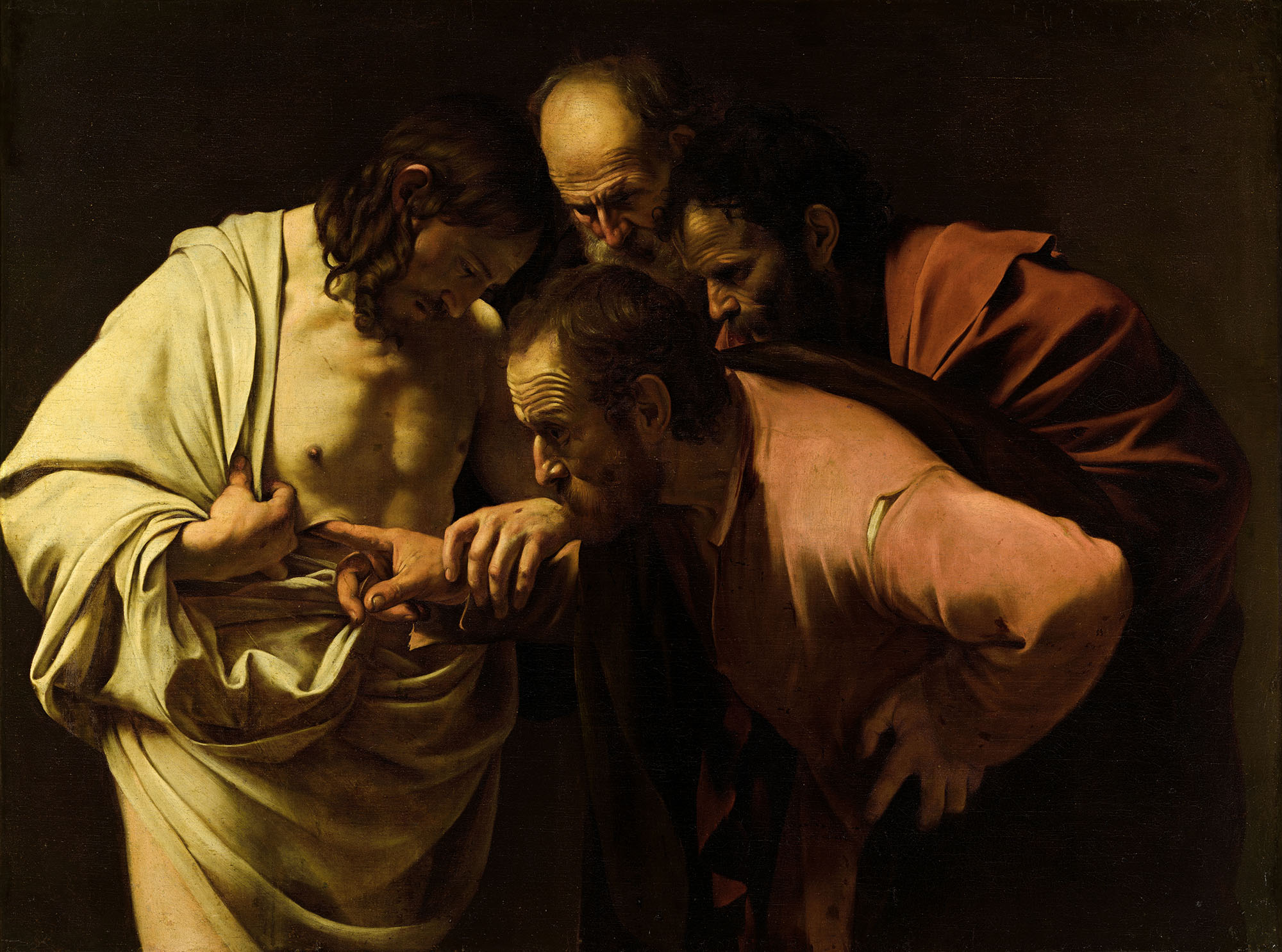
Juxtaposing Caravaggio’s “The Incredulity of Saint Thomas” with Márquez’s tale.

Flat illustration inspired by The Incredulity of Saint Thomas

The artwork used for comparison if Caravaggio’s painting in the early 17 century: “The Incredulity of Saint Thomas”. The image comes form a scene in the “Gospel of John”: after the resurrection, Thomas, having not witnessed it himself, openly declares that he will not believe in the resurrection unless he touches the wounds with his own hands. In the painting, Jesus holds Thomas’s hand and guides his fingers into the wound on his body. The background is pitch black, and a strong light falls on Jesus’s body and on Thomas’s face, forcing the viewer to follow their gaze and look directly at the wound.

The short story and the painting all descript a meeting between “holy” and ordinary person, but the treatment is completely different. In the painting of Caravaggio, the identity of Jesus is very clear: he is the resurrected Christ. Although His body still bears the wounds, the viewer has no doubt about who He is. Thomas’s task is simply to verify this fact by placing his hand into the wound and confirming it for himself. Through its stark contrast of light and shadow and its close composition, the painting calls this moment as an instant of “truth revealed.”

By contrast, in “A Very Old Man with Enormous Wings”, whether the old man is an angel is never resolved. The neighbor calls him an angel; however, the priest suspects he is a fake angle for scam, and the townspeople assign him different labels at different stages, but the story never offers a final answer. The sacred, in the novella, is a blurred and constantly contested identity rather than a certified fact.

In Caravaggio’s painting, Thomas’s suspense is stated as “do not believe”, but the picture does not just simply blame him: the painting puts his hand in the middle of the painting, encouraging the audience to feel that frightening but serious touch. In this context, suspense is a step towards faith: he dares to admit his disbelief and is willing to verify it by himself. However, in the short story, the townspeople’s suspense is more likely a kind of utilitarianism and rashness: they are not actually asking “who he is”, but to testing whether he is able to cure my illness or bring me good luck. When the evidence cannot fulfill their expectation, their reaction is not to continuously thinking, but to turn around and go to see the “spider woman” show. The short story and the painting formed a strong contradiction: one described how suspense leads to deeper faith, the other one revealed how suspense quickly slides to consumerism and ignorance.

In the short story and the painting, “body” is always a key media of indicating faith. In Caravaggio’s painting, Jesus proactively shows his wound and let Thomas touch it. This action reveals a kind of trust and closeness: his body is used to make others trust him. However, in the short story, the old man’s body is used as an object that can be consumed repeatedly: people used his feather for cure, but nobody really cares about how much he hurts. Putting those two artworks together, it is very easy to draw a very clear conclusion: even if people are given physical “proof,” they may not develop deeper moral care. What really decides how we treat an injured “other” is not how much proof we have, but whether we are willing to see him as a whole person.

Your Town Profile & Reflection

See how your choices align with the town or resist it.

What the Text Says About the World

Although the story happened in a town without a name, the world it descripted is very familiar: people quickly turned a possibly sacred being into a paid attraction. They treat his pain as entertainment, and they use his feathers as lucky charms for profit. This behavior is not limited to one time or one country. It points to a more common reality: in a society driven by profit and interest, anything unusual, fragile, or hard to understand can be turned into a product and then thrown away just as quickly when it is no longer useful. Many critics say that the story shows the decline of moral values and the lack of care for others in Latin America (where the author lives), but it can also be read as a warning about global consumer culture.

Personal Reflection

When I first read the story, it was easy for me to see the townspeople as a group of “obviously bad people”: They pulled out the old man’s feathers, threw stones at him, and kept him in a chicken coop like an animal. But after rebuilding the story through the interactive webpage, I started to realize that the problem may not be that simple. Many of the townspeople’s choices did not happen at a single moment. They came from fear, curiosity, poverty, and habits slowly piling up. If I lived in the same rainy, poor little town, would I also feel that “another chance to make money” is more realistic than “another moral burden”? This question makes me criticize them but also forces me to look back at myself.

When I place the story next to the real world, I think about how we watch other people‘s pain on the internet today. When we see a disaster video, we stop for a few seconds, read a few comments, and then move on to the next exciting clip. When we see someone who looks “strange,” we often make quick and harsh judgments in our minds, but rarely spend time trying to understand their situation. The townspeople in the story turned the old man’s suffering into a show by selling tickets, and sometimes we do something similar with our “clicks” and “shares.” Through this project, I learned at least one thing: when we face people who are hard to understand or whose identity is unclear, what truly matters may not be whether we understand them, but whether we are willing to see them as a whole person first.

In this interactive town, I gave a lot of similar choices with the original article: I give you the choice to lock the old man into the chicken coop, make money through charging every visitor, move attention from the old man to the weirder “spider woman”…… Through making these choices, it is easier for the readers to understand how Pelayo and Elisenda actually think: in their perspective the existence lying in the yard is not an old man needs care; instead, it is a chance for exploit. In the original story, their “filled their house with money in less than one week”, this detail is expressed in making choices step by step.

Through doing that they are doing, I discovered that actually we think of safety and profit instead of dignity or responsibility.

In the interactive experience, you tried to make choices that were opposite to the townspeople: you said no when others started to charge money, and you stayed with the old man when the Spider Woman appeared. These choices stand in clear contrast to the “collective coldness” in the story, and they helped you see the power of the text more clearly. The story is not saying that “there are no other possibilities,” but showing that in real life people often choose to give up those possibilities. Through this contrast, you can feel more of the challenge the story gives its readers: you can play the person who stays in the webpage, but in real life, would you still make the same choice?